

All of the taste, none of the guilt
Willie's Remedy+ is a perfect way to enjoy an evening without tomorrow's hangover.
Here are some classic craft cocktails loved by Willie.
These are all non alcohol twists that you'll love sipping
Willie's Remedy+ is a perfect way to enjoy an evening without tomorrow's hangover.
Here are some classic craft cocktails loved by Willie.
These are all non alcohol twists that you'll love sipping

Delta-9 and Delta-8 are closely related, intoxicating forms of THC. Delta-9 is the better-known and more extensively studied form, occurs naturally in greater amounts, and is generally stronger at a comparable dose. Delta-8 occurs naturally only in trace amounts, is usually produced commercially by converting hemp-derived CBD, and is less thoroughly researched. There is no reliable conversion chart between the two, both can affect a drug test, and neither is legal everywhere. Willie's beverages use USA-grown, hemp-derived Delta-9 THC. For adults 21 and older in legal markets only.
At comparable amounts, Delta-9 generally produces stronger effects. That does not give us a dependable conversion chart. Twenty milligrams of one is not automatically equal to ten of the other, and a different drink formula changes the picture again.
One carbon position separates the two cannabinoids. That small difference built two very different product categories.
Here is the plain-English guide to Delta 9 vs Delta 8, including what the difference means when the THC arrives in a can or a bottle.
Related guides: New to THC drinks? Start here | THC drink dosing | 10mg THC drinks guide | How long THC drinks take to kick in
|
Question |
Delta-9 THC |
Delta-8 THC |
|---|---|---|
|
Is it intoxicating? |
Yes |
Yes |
|
Where is its double bond? |
Ninth carbon |
Eighth carbon |
|
How much occurs naturally? |
Found in greater amounts in cannabis |
Naturally present only in small amounts |
|
How is it commonly produced? |
Usually extracted from cannabis or hemp |
Most commercial Delta-8 is made by converting CBD |
|
Which is generally stronger? |
Usually stronger at a comparable dose |
Usually less potent at a comparable dose |
|
Is there a reliable dose conversion? |
No |
No |
|
How much research exists? |
Considerably more |
Much less |
|
Can it affect a drug test? |
Yes |
Yes |
|
Is it legal everywhere? |
No |
No |
|
Can it be used in drinks? |
Yes |
Yes |
The useful takeaway is not that one is good and the other is bad. It is that the name, the dose, the testing, and local law all matter. A lighter reputation does not mean a lower dose.
Delta-8 and Delta-9 have the same basic molecular formula. The distinction comes from the location of a double bond in their chemical structures. Delta-8 has that double bond at the eighth carbon in the chain. Delta-9 has it at the ninth.
That small structural change affects how each cannabinoid interacts with receptors in the body, including the CB1 receptors associated with THC's intoxicating effects. It helps explain why the two can feel broadly similar while differing in potency.
You do not need to memorize the chemistry to choose a drink. Just remember that Delta-8 is not another name for CBD, and Delta-9 is not the only form of THC.
Delta-9-tetrahydrocannabinol is the cannabinoid people usually mean when they simply say THC. It is the primary intoxicating cannabinoid found naturally in cannabis.
Delta-9 has been studied for decades, though many questions remain about individual responses, long-term use, and newer beverage formulations. It can alter mood, perception, and judgment. Coordination and reaction time may also be affected.
Delta-9 may come from hemp or marijuana. Chemically, the Delta-9 molecule is the same. The source changes which legal and commercial framework may apply, not whether the compound can intoxicate you.
The complete product can still feel different based on its dose, other cannabinoids, ingredients, formulation, and how quickly it is consumed. A 5mg drink and a 20mg gummy are not interchangeable just because both contain Delta-9.
Willie's uses USA-grown, hemp-derived Delta-9 THC in its beverages.
Delta-8-tetrahydrocannabinol is another intoxicating form of THC. It occurs naturally in cannabis, but only in trace amounts.
There usually is not enough naturally occurring Delta-8 to extract efficiently for a large commercial market. Most Delta-8 sold in drinks, gummies, tinctures, and vapes is therefore made by chemically converting hemp-derived CBD. That does not turn Delta-8 back into CBD. The finished cannabinoid is intoxicating.
It also makes manufacturing quality especially important. A careful conversion and purification process is one thing. An unregulated one is another. Both may put hemp on the label, and the label alone does not tell you how the product was made or tested.
Delta-8 remains less thoroughly researched than Delta-9. That limits the certainty behind claims about its strength, duration, safety, and supposed ability to produce a universally gentler experience.
Generally, yes. At comparable oral doses, current evidence suggests Delta-9 tends to be more potent than Delta-8.
A recent controlled study found that oral Delta-8 produced dose-dependent effects similar in kind to Delta-9, but usually milder at comparable amounts. When the Delta-8 dose increased, the difference narrowed.
That does not establish a universal formula. The study was small, it used oral products under controlled conditions, and retail drinks differ in emulsification, ingredients, serving size, and pace of consumption. Individual tolerance adds another layer.
You may see claims that Delta-8 is exactly half as strong, two-thirds as strong, or 75 percent as strong as Delta-9. Those figures can provide rough historical context, but none should be treated as a personal dosing calculator.
A safer conclusion looks like this: Delta-8 is usually less potent at the same labeled amount, but enough Delta-8 can still produce effects comparable to Delta-9. Milder describes a tendency, not a guarantee.
The effects overlap because both are intoxicating forms of THC.
Either one may alter mood and sensory perception. Time awareness, attention, coordination, and short-term memory can shift as well. Some adults report feeling relaxed or talkative, and more engaged with whatever is in front of them. Others feel sleepy, anxious, or unsteady, or become uncomfortably aware of their own thoughts.
Delta-8 is often described as less intense. That may be true for some people at comparable doses. It is not guaranteed.
Your response depends on how many milligrams you consumed and how recently you last used THC. Food, medications, and drinking pace matter as well, along with how the beverage was formulated. So does the setting you are in.
Two people can drink the same amount and have different evenings. The same person can drink the same amount on two different weekends and still get a different answer. Individual response varies more than any comparison chart can capture.
The difference between Delta 9 drinks and Delta 8 drinks begins with the cannabinoid, but it does not end there.
Both products use beverage formulations intended to disperse an oil-loving cannabinoid through a mostly water-based drink. Some use nano-emulsion or related technology to create smaller droplets and potentially shorten the wait compared with a traditional edible. That formulation can matter as much as the number printed beside Delta.
|
What to Compare |
Delta 9 Drinks |
Delta 8 Drinks |
|---|---|---|
|
Primary cannabinoid |
Delta-9 THC |
Delta-8 THC |
|
Typical natural abundance |
More abundant in cannabis |
Present naturally in trace quantities |
|
Common commercial source |
Extracted from hemp or marijuana |
Usually converted from hemp-derived CBD |
|
Expected potency |
Generally stronger at equal amounts |
Generally less potent at equal amounts |
|
Research base |
More established |
Still limited |
|
Manufacturing question |
Extraction, formulation, and testing quality |
Conversion, purification, formulation, and testing quality |
|
Drug-test concern |
Yes |
Yes |
|
Legal consistency |
Varies by state |
Often even more variable by state |
|
Onset |
Depends on formulation, dose, food, and person |
Depends on formulation, dose, food, and person |
A 10mg Delta-8 drink and a 10mg Delta-9 drink contain the same weight of their respective cannabinoids. They do not necessarily create the same intensity. Delta-9 will generally be stronger at an equal dose. That does not mean a Delta-8 shopper should double the number, because the potency difference is not precise enough to support that kind of math.
The isomer alone does not determine onset. A well-formulated Delta-8 drink could be noticed sooner than a poorly formulated Delta-9 edible. Two Delta 9 drinks can also behave differently because one uses a fast-acting emulsion and the other does not. When comparing products, look at the formulation, serving instructions, and your own past experience rather than assuming the chemistry lesson can tell you exactly what minute the drink will arrive.
Both Delta 8 drinks and Delta 9 drinks may taste like ordinary soda or tea. That familiar format is part of the appeal, and it is also a reason to pay attention. A cold drink can disappear quickly, while the THC may take much longer to be felt. Pace it accordingly.
Because cannabis naturally produces very little Delta-8, most commercial Delta-8 begins as CBD. Manufacturers use chemical reactions to rearrange the CBD molecule into Delta-8 THC. A responsible producer should then purify the finished material and test it for potency, residual solvents, unwanted reaction byproducts, pesticides, heavy metals, microbes, and other relevant contaminants.
The concern is not that all conversion chemistry is automatically reckless. Chemistry built most of the useful things in your medicine cabinet and half the useful things under your sink. The concern is poor chemistry, incomplete purification, inconsistent testing, and products sold with more confidence than documentation.
Federal health agencies have warned about Delta-8 products with variable concentrations, misleading labels, and possible manufacturing contaminants. These concerns become more important when products are sold outside tightly regulated cannabis channels.
A laboratory report does not make for thrilling bedtime reading. Neither does discovering residual solvents after the fact.
A quality THC drink should make the important information easy to find.
First, identify the exact cannabinoid. The label should say whether the product contains Delta-8 THC, Delta-9 THC, or a combination. Cannabis-infused, hemp-derived, and full spectrum are not precise enough on their own.
Next, check milligrams per serving alongside the serving size in ounces. A 2-ounce shot, a 12-ounce can, and a 1.5-ounce tonic pour can each contain 10mg. Liquid volume and cannabinoid dose are separate numbers.
Then look at the total amount per container. A can may contain one serving, while a 750ml bottle may contain many. The total should not be mistaken for a single dose, and the single dose should not be mistaken for the whole bottle. Read both numbers before deciding what counts as one drink.
Review the complete cannabinoid panel too. Some drinks combine THC with CBD and CBG, among other cannabinoids. That information helps you compare formulas, but it does not guarantee a particular emotional or physical response. Ten milligrams of Delta-9 remains 10mg of Delta-9 when CBD is added.
Fifth, find a batch-specific certificate of analysis that matches the product you are holding. It should confirm cannabinoid potency and show which contaminants were screened. For converted Delta-8, residual-solvent and byproduct testing deserve special attention. For any THC drink, potency verification matters because the label is only useful when the liquid agrees with it. Willie's publishes its current Certificates of Analysis online.
Dose is personal. A serving that feels modest to a regular consumer may feel substantial to somebody trying THC for the first time.
In the Willie's lineup, 5mg is the natural starting serving. Adults who want less than 5mg do not need a microdose product: the Social Tonic is resealable, and a smaller measured pour lands wherever you want it. The bottle keeps for another evening.
|
Delta-9 THC Per Serving |
Who May Consider It |
Practical Approach |
|---|---|---|
|
Under 5mg |
THC-sensitive adults easing in |
Measure a smaller pour from the resealable Social Tonic and give it ample time |
|
5mg |
Adults starting out, or anyone keeping the evening light |
One 5mg serving or a measured 0.75-ounce half pour of the 10mg bottle; no automatic refills |
|
10mg |
Experienced consumers with a known tolerance |
Treat it as one deliberate serving or divide it into two measured pours |
|
More than 10mg |
Adults with substantial THC experience |
Larger amounts raise the likelihood of unwanted effects and longer impairment |
This table applies to Delta-9 and should not be used as a Delta-8 conversion chart. Being experienced with Delta-9 also does not guarantee that you understand a particular Delta-8 product, since the formulation, label accuracy, and cannabinoid profile may differ. Adults still finding their level should use the THC drink dosing guide from 5mg to 10mg, and the beginner's guide to THC drinks covers the basics before the milligrams start asking questions.
The useful dose is the one you chose deliberately, before the first sip.
Either type of THC drink can take time. Some fast-acting beverage formulations may begin to be noticeable in approximately 15 to 45 minutes. Ingested cannabis products can also take up to two hours to produce their full intoxicating effects. Food and drinking pace move the clock. So do tolerance, medications, and the way the beverage was formulated.
A practical approach is to choose the serving first, note your start time, sip gradually, and give it up to two hours before deciding how it fully affected you. Do not use a second can as a stopwatch. Most of the trouble comes from adding more during that window. The complete guide to how long THC drinks take to kick in explains onset, meals, duration, and redosing in more detail.
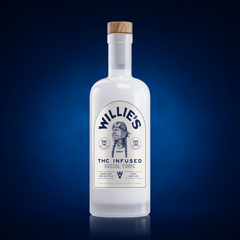
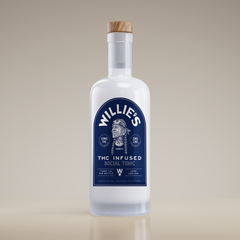
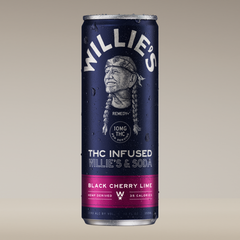
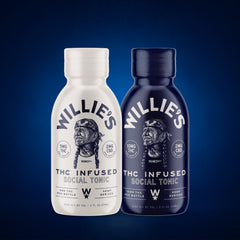
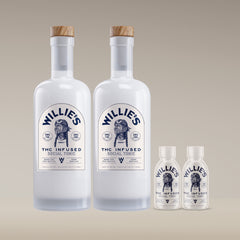
Willie's current beverage lineup uses hemp-derived Delta-9 THC rather than Delta-8. That choice keeps the formula centered on the form of THC consumers are most familiar with and researchers have studied more extensively. It also lets the dose sit plainly on the label, whether the drink comes in a can, measured tonic pour, or compact shot.
|
Willie's Format |
Labeled Serving |
How It Fits the Moment |
|---|---|---|
|
Willie's & Soda |
10mg Delta-9 THC in a 12-ounce can |
A ready-to-drink option made for slow sipping |
|
10mg THC Social Tonic |
10mg Delta-9 THC in a measured 1.5-ounce pour |
Home bars, longer alcohol-free drinks, and adjustable pours |
|
10mg THC Shots |
10mg Delta-9 THC in a 2-ounce bottle |
A compact, premeasured serving |
|
Clearly Labeled Delta-9, Three Ways Explore Willie's & Soda, pour from the 10mg THC Social Tonic, or keep it compact with 10mg THC Shots. |
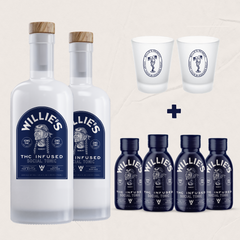
The Social Tonic contains 17 labeled servings. A properly measured 0.75-ounce half pour contains approximately 5mg of THC, while the full 1.5-ounce serving contains 10mg. A jigger keeps the pour honest. The current Social Tonic and shot formulas also list 2mg CBD, 2mg CBG, and 200mg L-theanine per serving; those amounts describe what is in the product, not how every person will feel. For a fuller look at the stronger serving lane, visit the 10mg THC drinks guide, and the THC shots guide explains how compact servings compare with cans and spirit-style bottles.
There is not enough evidence to call Delta-8 inherently safer.
Delta-8 may feel less intense at the same amount, but it remains intoxicating and can impair coordination, judgment, and attention. A larger Delta-8 dose can narrow the potency difference substantially. Retail Delta-8 can also bring an added quality-control question, because most of it is chemically converted from CBD, and incomplete purification or unreliable testing may introduce risks that have little to do with the cannabinoid's basic potency.
Delta-9 products are not automatically safe merely because they contain a more familiar molecule. Dose and testing still matter. So do labeling, age controls, and how the product is actually used.
The better question is not which name sounds gentler. It is whether you know exactly what the product is, how much is in it, and whether the batch was properly tested.
The legal answer depends on the product, source, state, and date.
Current federal law defines hemp using a limit of no more than 0.3 percent Delta-9 THC on a dry-weight basis. That framework helped create markets for hemp-derived Delta-9 beverages and Delta-8 products.
State laws can be stricter. Some states permit certain hemp-derived THC drinks under rules covering age, testing, dosage, and retail sale. Others restrict or prohibit Delta-8, Delta-9 beverages, or both.
Federal law is also scheduled to change. An amendment set to take effect on November 12, 2026 would move the federal definition toward total THC, exclude certain cannabinoids manufactured outside the plant, and exclude final hemp-derived cannabinoid products containing more than 0.4mg of combined THC-like cannabinoids per container. Unless that law changes before its effective date, it would affect much of the current intoxicating hemp beverage market, not just Delta-8.
Do not rely on an old article or a social post. Check current local rules before buying, carrying, or traveling with either cannabinoid. Willie's ships only where permitted and requires age verification; confirm availability at checkout. The where to buy THC drinks guide covers shipping and state rules in more detail.
Delta-8 and Delta-9 call for the same basic respect.
Choose the dose before you begin. Sip slowly. Give the first serving time before considering anything else. Do not combine THC with alcohol or other intoxicating substances, since mixing can increase impairment and makes the experience harder to predict. Choose one or the other.
Do not drive, operate machinery, cycle in traffic, or make safety-sensitive decisions after consuming THC. Feeling comfortable does not mean your reaction time has returned to normal.
Store THC drinks separately from ordinary soda, tea, and juice. Keep them secured away from children and pets. At a gathering, keep infused drinks labeled and separate from everything else on the table.
THC products are intended for adults 21 and older where lawful. Avoid THC during pregnancy or breastfeeding. Speak with a physician or pharmacist before use if you take medication, have a heart condition, or manage another health concern.
No alcohol does not mean no impairment.
Generally, yes. Controlled research suggests Delta-9 produces stronger effects than the same amount of Delta-8. Larger Delta-8 doses can close that gap, so Delta-8 should not be treated as non-intoxicating or automatically mild.
No. Most commercial Delta-8 is made by converting hemp-derived CBD, but the finished Delta-8 is an intoxicating form of THC. CBD itself does not produce the same intoxicating effects.
The Delta-9 molecule is chemically the same. The source affects its legal and commercial category. The finished experience can still vary because of dose, formulation, other cannabinoids, ingredients, and serving pace.
It can. Common urine cannabinoid screens can react strongly to Delta-8 metabolites. Do not treat Delta-8 as drug-test safe merely because the label does not say Delta-9.
Not necessarily. Onset depends heavily on the drink's formulation, dose, food, individual metabolism, and pace of consumption. The isomer alone does not tell you which beverage will be noticed first.
It is better not to stack them casually. Both contribute to the total intoxicating dose, and the combined effect can be harder to predict. A product containing more than one THC isomer should disclose the amount of each and the total per serving.
No. State rules vary and change frequently. Some states regulate Delta-8 through licensed cannabis systems, while others restrict or prohibit it. Check the current law where you live and anywhere you plan to travel.
No. Hemp-derived Delta-9 products may be permitted in some states and restricted in others. Product type and dose can matter. So can packaging, the retailer, and age rules.
Not automatically. A supposedly milder cannabinoid in an unclear or inaccurately labeled product is not necessarily a better starting point. New consumers should prioritize a low, clearly stated THC dose, batch testing, straightforward ingredients, and plenty of time.
Yes. Delta-8 is sold in infused beverages, along with gummies, tinctures, and other formats. As with any THC drink, check the exact isomer, dose per serving, total per container, formulation, and laboratory report.
The difference between Delta 9 and Delta 8 is real, but the cannabinoid name is only part of the decision. Delta-9 is more abundant, better researched, and generally stronger at the same amount. Delta-8 is usually converted from CBD, tends to be less potent at comparable doses, and carries additional questions around manufacturing and regulation. Neither one should be judged by reputation alone.
Read the label, check the batch report, know the milligrams, and give the drink time. Do not drive afterward.
Then get back to the actual reason you poured something in the first place: good company, a decent song, and no particular need to be anywhere else.
Explore the current Willie's & Soda collection, build an alcohol-free drink with the 10mg THC Social Tonic, or keep the serving compact with 10mg THC Shots.
Michigan Cannabis Regulatory Agency: Delta-8 information
National Library of Medicine: Delta-8-THC, Delta-9-THC's nicer younger sibling?
CDC: Cannabis frequently asked questions
For adults 21 and older in legal markets only. Do not drive or operate machinery after consuming THC. Keep out of reach of children and pets. If you are pregnant, nursing, or taking medications, consult a healthcare provider first.
These products contain hemp-derived Delta-9 THC and are intended for adults 21 and older. Must comply with local and state laws. These statements have not been evaluated by the Food and Drug Administration. This product is not intended to diagnose, treat, cure, or prevent any disease.


